Embervale Location Briefing
A Chronicle of Key Sites
Introduction: The Geography of a Fallen Kingdom
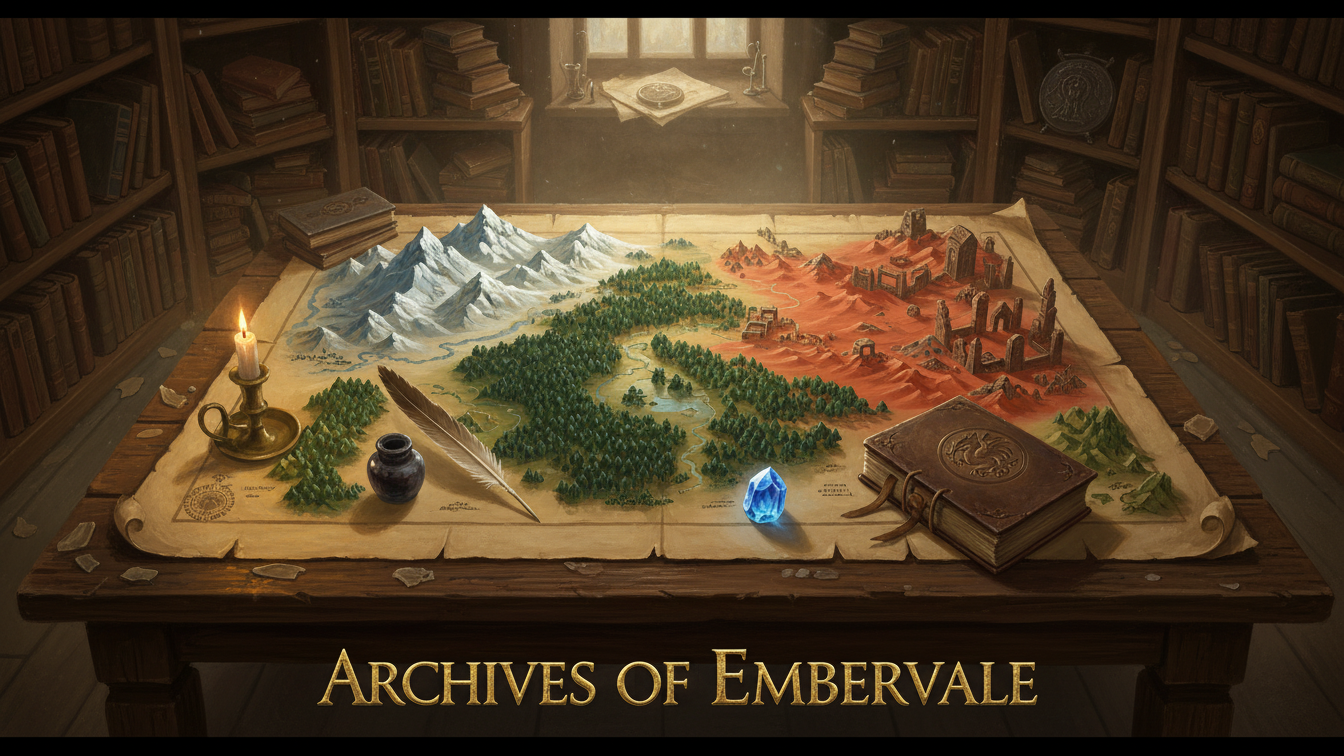
The geography of Embervale is not merely a landscape, but a narrative map charting the course of a great kingdom's history, its gradual decline, and the cataclysmic events of the Elixir Wars and the arrival of the Shroud. Each ruined fortress, desolate waste, and blighted forest tells a piece of the story. The terrain itself is a silent chronicler of political corruption, desperate ambition, and the profound ecological disaster that followed.
As a chronicler of this broken land, I have learned to read the stories etched in its very stone and soil. This document serves as a consolidated guide to Embervale's most significant locations, detailing the history, pivotal events, and key figures associated with each site, offering a clearer understanding of how this world was broken.
1.0 Revelwood: The Heart of the Old Kingdom
Revelwood was once the thriving political and cultural center of Embervale, the verdant seat of the Pikemead dynasty. Under the reign of the beloved Queen Pikemead, the region flourished. However, it was also here, under her less capable son, King Gormander, that the kingdom's internal decay festered. This political rot would create a power vacuum that external forces, born from the greed festering in the distant north, would later exploit, setting the stage for the civil strife of the Elixir Wars and the eventual, all-consuming arrival of the Shroud.
1.1 Pikemead's Reach: The Fallen Capital
The sprawling city of Pikemead's Reach was the jewel of Embervale, a bustling capital that prospered under Queen Pikemead. After her passing, control fell to her son, King Gormander, whose ineffectual and self-absorbed rule coincided with the city's catastrophic decline. The capital's demise was not the result of a single event, but a fatal confluence of environmental collapse and military conquest.
| Environmental Collapse | Military Conquest |
|---|---|
| The Shroud's corruption was not limited to the air; it seeped into the soil and water table. Lore entries like "The River Breaks Out" describe how the river began to flood with odd-tasting water, weakening the soil and causing the city's formidable walls to crumble. This environmental decay left the capital vulnerable and its people demoralized. | Exploiting the chaos, the northern armies of Lord Vorgoth marched south, initiating the Elixir Wars. Pikemead's Reach was besieged and, with its defenses compromised and its leadership failing, eventually fell to the invaders. The conflict left the once-proud capital in ruins (See: The Cornflower Twilight). |
- Queen Pikemead: The widely adored former ruler of the kingdom (Subject of Ode to Pikemead).
- King Gormander: Pikemead's insecure and vain son, whose reign saw the capital's fall.
- Ramone Jones: Editor of "The Pike Weekly" and a vocal critic of King Gormander, who was accused of treason, forcing him into hiding.
1.2 Imperial Gardens: Gormander's Folly
The Imperial Gardens stand as the most poignant architectural evidence of King Gormander's failed leadership and profound detachment from his people's suffering. While the kingdom grappled with famine, flooding, and the growing threat of the Shroud, Gormander focused on self-aggrandizing projects. Lore such as "Gormander Watches Over Us" and the newspaper clipping "The Pike Weekly: Nothing Grand About Gormander" reveal that he renamed the gardens after himself and commissioned statues in his own honor, embezzling funds while his subjects faced ruin.
1.3 Mistbury Catacombs: The Royal Tomb
These catacombs serve as the final resting place of the esteemed Queen Pikemead. The entrance is sealed by a puzzle, with a stone tablet bearing a riddle that serves as a clue to its solution. The riddle is also deeply prophetic:
"One to Glory, One to Ice, One to Rule, and One to Life."
This inscription prophetically outlines the fates of the Queen's four children. "Glory" refers to the Queen herself, immortalized in memory. "Ice" points to the eldest son, Lord Vorgoth, in his cold northern domain. "Rule" signifies the incompetent King Gormander. Finally, "Life" suggests Queen Jezmina, who fought to lead her people to safety.
1.4 Glenwood's End: A Town Lost to Elixir
The tragic tale of Glenwood's End exemplifies the destructive social impact of the Elixir. The town's decline began with a visit from a "Mysterious Wanderer," who introduced the populace to the potent substance. What followed was a rapid descent into widespread addiction and obsession, a societal decay that culminated in open rebellion.
Royal Investigation: Alarmed by the town's sudden silence, King Gormander dispatched Royal Inquisitor Lachlan to investigate.
Rebellion: Lachlan discovered an illegal Elixir distillery and the town's decay into madness. Before he could report back, he was murdered by the townspeople, who sent his severed head to the king as a defiant message.
Failed Retaliation: Gormander's retaliatory force of soldiers was met with shocking ferocity. The Elixir-empowered townspeople, their strength unnaturally enhanced, defeated the royal army, securing their violent autonomy.
The decay that rotted the kingdom from its core in Revelwood soon spread to the borderlands, where Embervale's last true defenders made their final stand.
2.0 The Springlands: Bastions of a Last Stand
The Springlands served as a critical border region, a buffer between the kingdom's heartland and the encroaching dangers from without. It was here that some of Embervale's most formidable defensive fortifications were built, and it was here that the final, desperate struggles against the Shroud and hostile armies took place. The ruins scattered across this region are not of ancient civilizations, but of the kingdom's last gasps.
2.1 Longkeep: A Defiant Fortress
Longkeep was a major defensive bastion of immense strategic importance. It was the intended destination for the "Southern Caravan," a massive train of refugees led by Queen Jezmina fleeing the drought-stricken Kindlewastes. The fortress's final days are chronicled in the grim entries of the "Captain's Journal". The captain recounts his doomed efforts to defend the keep against overwhelming forces, protect the civilian refugees, and, crucially, safeguard the Cinder Vaults where the Flameborn were sealed. A poignant "Love Letter to Queen Jezmina" found within the ruins highlights the deeply personal stakes of this final, kingdom-shattering conflict.
2.2 Braelyn Bridge: A Captain's Demise
This vital stone crossing became the final battleground for the heroic captain of Longkeep. After the fortress fell, he and his few remaining guards made a last stand at the bridge, ultimately meeting their end in the deadly Shroud that swirled in the chasm below. His body, discovered decades later, still carried the "Sigil Ring of the Elder Guards," a symbol of his unwavering and tragic loyalty. (See: The Ballad of Braelyn Bridge and The Last Oath).
2.3 Woodgard: A Ruined Sanctuary
The town of Woodgard, centered around its prominent church, became a sanctuary for refugees fleeing the chaos of the Elixir Wars. Lore notes like "The Church Was Destroyed!" tell of its eventual fall. The town was overrun, its church sacked, and the crypts beneath it became infested with a permanent, deadly pocket of Shroud, twisting a place of solace into one of perpetual horror.
The shattering of the kingdom's military power did not create a void, but rather a fertile ground for a new, savage order to take root in the lawless territories.
3.0 The Nomad Highlands: Scavenger Dominions
The Nomad Highlands are a harsh landscape of mesas and arid plains that became the primary territory for Elixir-crazed Scavengers after the kingdom's fall. However, while all Scavengers are defined by their addiction, their circumstances differ by region. Unlike those in the south, whose settlements were destroyed during the Elixir Wars, the Highland and Summit Scavengers inhabit lands ravaged not by human conflict, but by the Shroud-born Fell Dragon. Their settlements and crude fortifications reflect a desperate, ongoing struggle against this monstrous threat rather than just societal collapse.
3.1 Raven's Keep: Rise of a Matron
Originally a royal prison, Raven's Keep became a cradle of Scavenger leadership during the chaos of Embervale's fall. The "Prison Break" lore collection recounts the story of a prisoner named Lupa. When the prison was abandoned, she orchestrated a riot, escaped her cell, and through sheer ferocity and cunning, established herself as a powerful Scavenger Matron, a leader among the lawless.
3.2 Surat's Rest: A Hub of Anarchy
Surat's Rest evolved into a central gathering point for the disparate Scavenger bands of the Highlands. Part trading post, part gladiatorial arena, it is a hub of anarchy. Lore entries such as "Caravan Raid" and the darkly humorous "Nursery Supplies" (a coded term for illicit goods) paint a picture of a society defined by violence, theft, and a thriving black market for anything that can be scavenged or smuggled.
While the Highlands descended into a chaos of human madness, the queendom to the east succumbed to a quieter, ecological catastrophe born from the same poisoned source.
4.0 The Kindlewastes: A Kingdom Turned to Dust
The vast desert of the Kindlewastes was once the viable, independent domain of Queen Jezmina. This eastern queendom was not felled by war, but by a devastating environmental cataclysm. As the Elixir wells in the distant north poisoned the world, the Shroud's corruption seeped deep into the earth, contaminating the water table. This led to a great drought that choked the life from the land, turning Jezmina's kingdom to dust and forcing a desperate exodus.
4.1 Lapis and the Southern Caravan
Faced with widespread famine and the death of her lands, Queen Jezmina organized a massive refugee exodus known as the "Southern Caravan". This desperate train of survivors departed from the town of Lapis, located in the far east, with the goal of trekking west across the continent to the promised safety of Longkeep. Lore from the "Southern Caravan" collection and "Mystery of Eldermere Dam" chronicle this arduous journey and the environmental collapse that prompted it. (Listen to: Leather and Bone).
4.2 The Sun Temple: An Echo of War
A significant landmark in the wastes, the Sun Temple holds a crucial clue to the nature of the Shroud. Within its halls, Shroud-infected creatures can be found wearing the distinct armor of Lord Vorgoth's northern army. As Vorgoth's military campaign never reached this far south, their presence reveals the terrifying truth of the Shroud: it is not a mindless fog, but a hive-mind intelligence. The "Shroud organism" took control of these fallen soldiers and, long after the Elixir Wars had ended, directed them as puppets to continue its own purpose: to spread and consume.
Queen Jezmina's flight from her ruined home was an effect of the Shroud; her brother's domain in the north was its cause.
5.0 Albaneve Summits: The Source of the Blight
The icy, forbidding peaks of the Albaneve Summits form the northernmost region of Embervale. This was the domain of Lord Vorgoth, the ambitious elder brother of the Pikemead line. More critically, this remote and mineral-rich land was the epicenter of the large-scale Elixir extraction that served as the catalyst for every disaster that followed. It was from the wells dug into these mountains that the Shroud was first unleashed upon the world.
5.1 Elixir Wells and the Fell Dragon
Driven by greed and a lust for power, Lord Vorgoth established a massive Elixir well industry throughout the mountains. The consequence of this reckless endeavor was catastrophic. The Shroud, a byproduct of the extraction, seeped into the rock and corrupted a long-dormant dragon egg hidden deep within the peaks. This corruption forced the egg to hatch, unleashing a young Fell Dragon. This monstrous beast, born of the Shroud, wreaked havoc across the Summits, terrorizing and destroying Vorgoth's own settlements and forces.
5.2 Howling Peak: Vorgoth's Fate
Howling Peak was a central fortress in Lord Vorgoth's northern domain. While his ultimate fate remains shrouded in mystery, the lore inscribed on the "Guard of the North" armor set offers a compelling legend. It claims that the Ancients—the god-like, otherworldly beings who shaped Embervale—grew weary of Vorgoth's destructive ambition and ultimately pushed him from the summit, casting him down into the Shroud to be consumed.
However, some readings of the lore suggest a more sinister timeline—that the Ancients' intervention occurred before the wars, not as a punishment, but as a deliberate act to turn Vorgoth into a living weapon for the Shroud organism, making him the war's catalyst rather than just its leader.
- Lord Vorgoth: Eldest son of Queen Pikemead, ruler of the north, and the architect of the Elixir industry.
Conclusion: A World Etched by Ruin
The diverse locations of Embervale are far more than mere places on a map; they are the chapters in a sweeping narrative of a kingdom's self-destruction. This chronicle of ruin flows from the political corruption and vanity rotting the kingdom's core in Revelwood, to the desperate last stands of a dying order in the Springlands. It charts the ecological disasters born of avarice in the Kindlewastes and the rise of anarchic human remnants in the Nomad Highlands. Ultimately, every tragedy, every battlefield, and every blighted landscape can be traced back to a single source: the insatiable greed for Elixir that first took root in the icy peaks of the Albaneve Summits, poisoning the land and its rulers from the top down.